
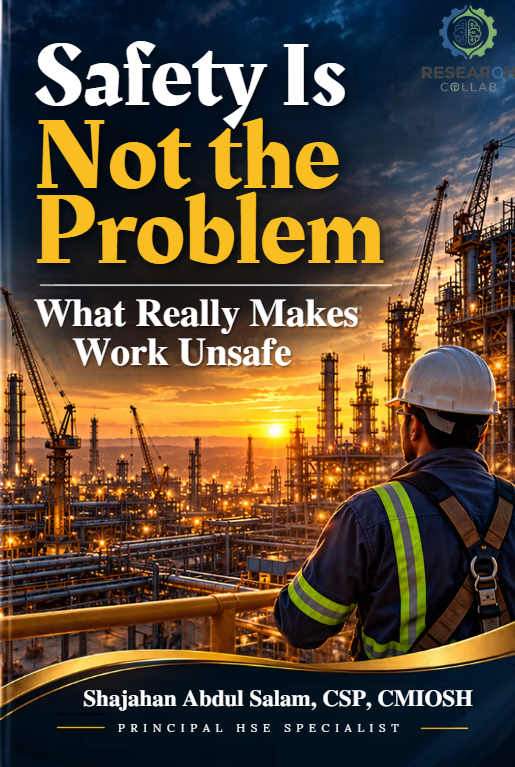
Safety Is Not the Problem: What Really Makes Work Unsafe
##plugins.pubIds.doi.readerDisplayName##
https://doi.org/10.5281/zenodo.23558148
Keywords:
Occupational Health and Safety, Safety Management, Risk Assessment, Human Factors, Safety Leadership, Incident PreventionSynopsis
Safety is often discussed through procedures, regulations, risk assessments, permits, and compliance requirements. While these are essential elements of effective safety management, they do not always explain why unsafe situations continue to occur despite established systems and documented controls. This book, Safety Is Not the Problem: What Really Makes Work Unsafe, explores the gap between how work is planned and how it is actually performed, drawing on practical insights from construction, industrial operations, and project environments. It examines how planning, financial constraints, competence, leadership, supervision, scheduling, and commercial pressures influence workplace safety. Rather than attributing incidents solely to individual mistakes, the book encourages readers to examine the organizational and operational conditions that shape human decisions and make unsafe practices possible, predictable, or acceptable.
The purpose of this book is not to replace established safety procedures or introduce another collection of compliance checklists, but to promote critical thinking, practical observation, and meaningful conversations about workplace risk. The examples and reflections are intended to support learning rather than assign blame, with details generalized where necessary to protect individuals and organizations. Written for HSE professionals, supervisors, project managers, engineers, contractors, and organizational leaders, the book encourages readers to connect safety principles with the realities of everyday work. Ultimately, effective safety depends not only on procedures and documentation but also on sound decisions, responsible leadership, and working conditions that enable people to perform their jobs safely. Readers are invited to look beyond the rules, understand the work, question the system, and take practical steps towards creating safer workplaces.
References
Reason, J. (1997). Managing the Risks of Organizational Accidents. Ashgate Publishing.
Hollnagel, E. (2014). Safety-I and Safety-II: The Past and Future of Safety Management. Ashgate Publishing.
Dekker, S. (2014). The Field Guide to Understanding 'Human Error' (3rd ed.). Ashgate Publishing.
International Labour Organization. (2001). Guidelines on Occupational Safety and Health Management Systems (ILO-OSH 2001). International Labour Office. https://www.ilo.org/publications/guidelines-occupational-safety-and-health-management-systems-ilo-osh-2001
International Organization for Standardization. (2018). ISO 45001:2018 Occupational Health and Safety Management Systems—Requirements with Guidance for Use. ISO. https://www.iso.org/standard/63787.html
Published
20 October 2026
Copyright (c) Shajahan Abdul Salam
Details about the available publication format: E-Book
E-Book
ISBN-13 (15)
978-81-17491-09-6
Details about the available publication format: Book (Paperback)
Book (Paperback)
ISBN-13 (15)
978-81-17491-08-9
How to Cite
Download Citation







 WhatsApp +91 6002313260