
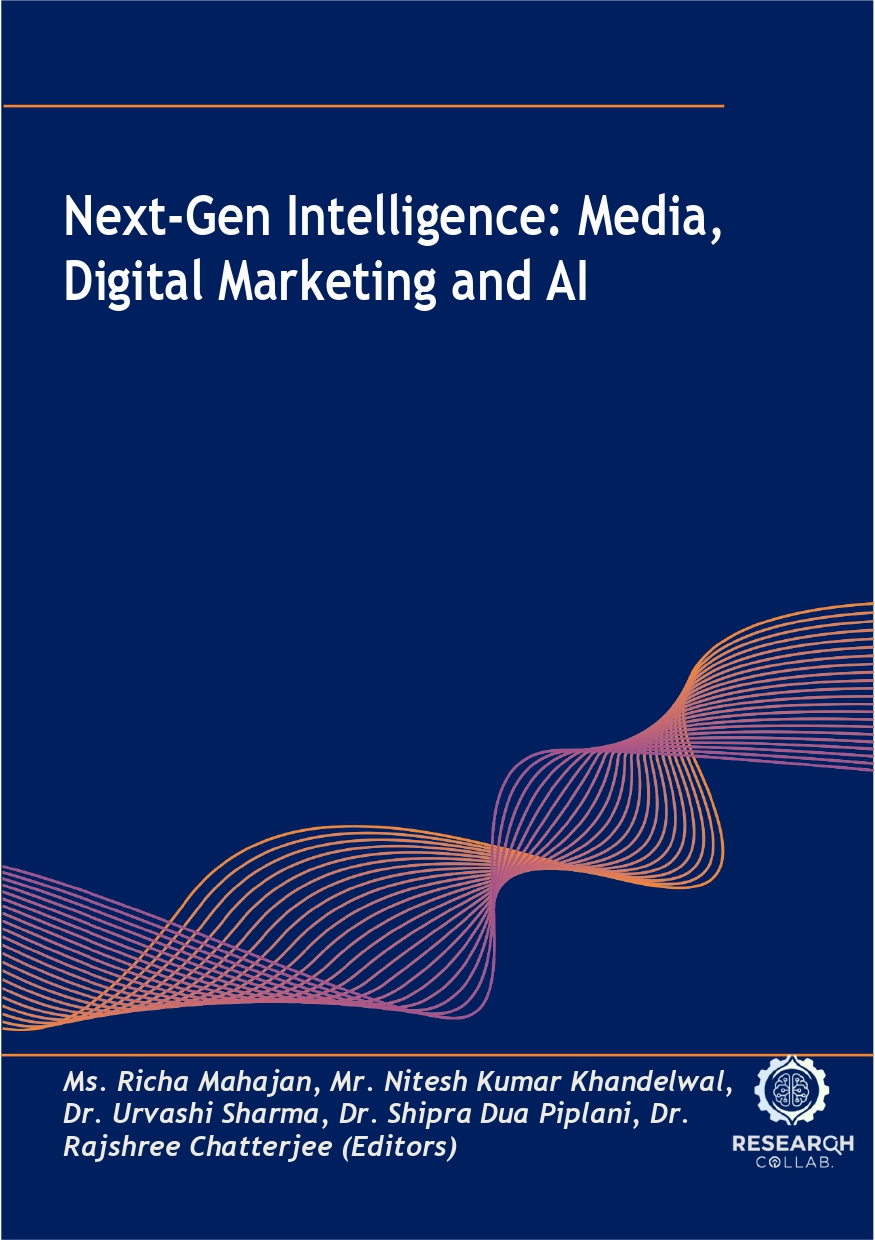
Next-Gen Intelligence: Media, Digital Marketing and AI
##plugins.pubIds.doi.readerDisplayName##
https://doi.org/10.5281/zenodo.23308752
Keywords:
Artificial Intelligence, Generative AI, Digital Media, Journalism, Digital Marketing, AI Ethics, AI Governance, Digital Transformation, Consumer Behaviour, Media Literacy, Deepfakes, Misinformation, Digital Culture, Responsible AI, Business InnovationSynopsis
Next-Gen Intelligence: Media, Digital Marketing and AI is an interdisciplinary edited volume examining the rapidly changing relationship between artificial intelligence, media, communication, digital marketing, education, business, governance, and society. Bringing together diverse scholarly and conceptual perspectives, the book explores AI-enabled journalism, citizen journalism, agentic AI, photography, deepfakes, misinformation, digital literacy, journalism education, scholarly communication, EdTech, consumer behaviour, personalisation, branding, and strategic business transformation. It also addresses ethical and governance concerns including algorithmic bias, privacy, transparency, accountability, human oversight, credibility, digital inclusion, and responsible AI adoption. Several chapters focus on the Indian context, including digital governance, political mobilisation, pluralistic news environments, education, and emerging business practices. Collectively, the volume presents AI not merely as a technological tool but as a transformative force influencing professional practices, institutions, markets, and everyday digital culture. It offers researchers, educators, students, media professionals, managers, and policymakers a broad perspective on opportunities, challenges, and responsible pathways for navigating the next generation of intelligent digital ecosystems.
References
Dwivedi, Y. K., et al. (2023). So what if ChatGPT wrote it? Multidisciplinary perspectives on opportunities, challenges and implications of generative conversational AI for research, practice and policy. International Journal of Information Management, 71, 102642. https://doi.org/10.1016/j.ijinfomgt.2023.102642
Floridi, L., & Chiriatti, M. (2020). GPT-3: Its nature, scope, limits, and consequences. Minds and Machines, 30, 681–694. https://doi.org/10.1007/s11023-020-09548-1
Gillespie, T. (2014). The relevance of algorithms. In T. Gillespie, P. J. Boczkowski, & K. A. Foot (Eds.), Media Technologies: Essays on Communication, Materiality, and Society (pp. 167–194). MIT Press.
Kaplan, A., & Haenlein, M. (2019). Siri, Siri, in my hand: Who’s the fairest in the land? On the interpretations, illustrations, and implications of artificial intelligence. Business Horizons, 62(1), 15–25. https://doi.org/10.1016/j.bushor.2018.08.004
Kietzmann, J., Paschen, J., & Treen, E. (2018). Artificial intelligence in advertising: How marketers can leverage artificial intelligence along the consumer journey. Journal of Advertising Research, 58(3), 263–267. https://doi.org/10.2501/JAR-2018-035
Marconi, F. (2020). Newsmakers: Artificial Intelligence and the Future of Journalism. Columbia University Press.
McStay, A. (2018). Emotional AI: The Rise of Empathic Media. SAGE Publications.
Newman, N., Fletcher, R., Robertson, C. T., Ross Arguedas, A., & Nielsen, R. K. (2024). Reuters Institute Digital News Report 2024. Reuters Institute for the Study of Journalism, University of Oxford. https://reutersinstitute.politics.ox.ac.uk/digital-news-report/2024
Russell, S., & Norvig, P. (2021). Artificial Intelligence: A Modern Approach (4th ed.). Pearson.
UNESCO. (2021). Recommendation on the Ethics of Artificial Intelligence. United Nations Educational, Scientific and Cultural Organization. https://unesdoc.unesco.org/ark:/48223/pf0000381137
UNESCO. (2023). Guidelines for the Governance of Digital Platforms: Safeguarding Freedom of Expression and Access to Information through a Multi-Stakeholder Approach. United Nations Educational, Scientific and Cultural Organization. https://www.unesco.org/en/internet-trust/guidelines
Verma, S., & Bhattacharyya, S. S. (2017). Perceived strategic value-based adoption of Big Data Analytics in emerging economy: A qualitative approach for Indian firms. Journal of Enterprise Information Management, 30(3), 354–382. https://doi.org/10.1108/JEIM-10-2015-0099
Wolters, P. (2019). Artificial intelligence and the future of digital marketing. In relevant research on AI-enabled marketing and consumer engagement.
Published
30 September 2026
Copyright (c) 2026 Richa Mahajan, Nitesh Kumar Khandelwal, Urvashi Sharma, Shipra Dua Piplani, and Rajshree Chatterjee
Details about the available publication format: E-Book
E-Book
ISBN-13 (15)
978-81-180547-1-9
Details about the available publication format: Book (Paperback)
Book (Paperback)
ISBN-13 (15)
978-81-180547-0-2
How to Cite
Download Citation





 WhatsApp +91 6002313260