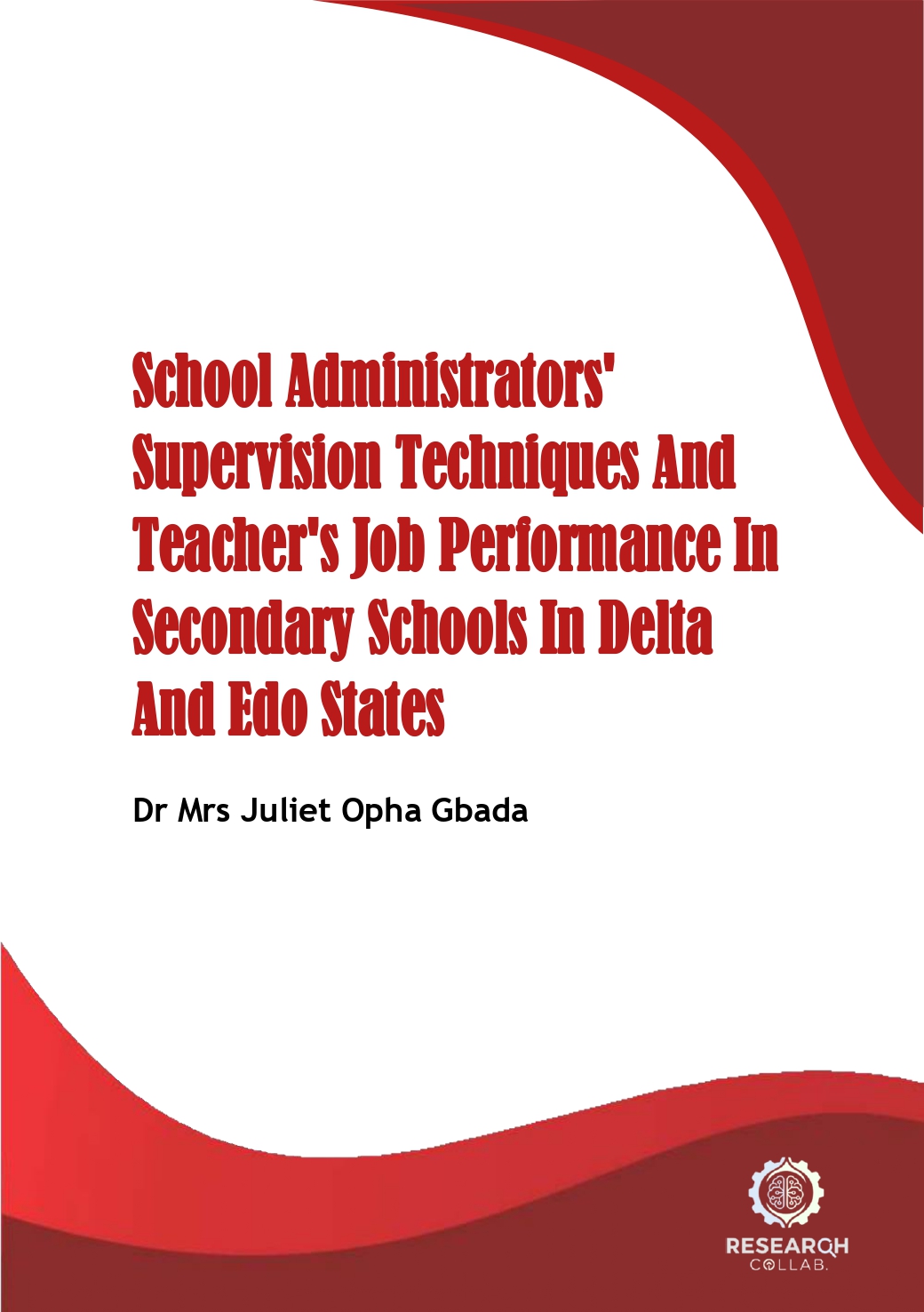
School Administrators' Supervision Techniques And Teacher's Job Performance In Secondary Schools In Delta And Edo States
##plugins.pubIds.doi.readerDisplayName##
http://doi.org/10.5281/zenodo.21543127
Keywords:
School administration, supervision techniques, teachers' job performance, instructional supervision, secondary schoolsSynopsis
This study examined the relationship between school administrators’ supervision techniques and teachers’ job performance in secondary schools in Delta and Edo States, Nigeria. The study was motivated by the persistent decline in students’ academic achievement, which has been associated with ineffective supervisory practices and poor teacher job performance. A descriptive survey research design was adopted, and data were collected using a self-designed questionnaire validated through Principal Component Analysis (PCA). The reliability of the instrument was established using Cronbach’s Alpha to determine internal consistency. The study was guided by eight research questions and eight null hypotheses. A total of 2,090 respondents, comprising 70 school inspectors, 120 principals, and 1,900 teachers, were randomly selected from a population of 20,927 participants. Descriptive statistics (mean scores) were used to answer the research questions, while Analysis of Variance (ANOVA) at the 0.05 level of significance was employed to test the hypotheses. The findings revealed that full inspections and surprise visits were the most frequently used inspection techniques, whereas classroom visitations and staff meetings were the most common instructional supervision practices. Effective implementation of inspection and instructional supervision techniques was found to enhance principals’ administrative effectiveness and teachers’ classroom performance, provided that adequate funding, qualified personnel, and sufficient instructional resources were available. Major challenges identified included inadequate funding, insufficient facilities, weak policy implementation, overcrowded classrooms, poor teachers’ conditions of service, and the increasing number of schools. The study also found no significant difference among the views of school inspectors, principals, and teachers regarding the use of supervision techniques. Based on the findings, the study recommends greater use of special inspections and recognition visits, improved educational funding, enhanced policy implementation, better teacher welfare, and the provision of a conducive teaching and learning environment to strengthen supervision practices and improve teachers’ job performance.
References
Akinwumiju, J. A. (1995). Educational supervision, inspection and introduction to teaching. Atlantic Associated Publishers.
Afolabi, F. O., & Loto, A. B. (2008). The headmaster and quality control in primary education through effective instructional supervision in Nigeria. Journal of Social Sciences, 17(1), 21–26.
Arong, F. E., & Ogbadu, M. A. (2010). Major causes of declining quality of education in Nigeria from administrative perspective. Canadian Social Science, 6(3), 183–198.
Ayeni, A. J. (2012). Improving school and community partnership for sustainable quality assurance in secondary schools in Nigeria. International Journal of Research Studies in Education, 1(1), 95–102.
Blasé, J., & Blasé, J. (2004). Handbook of Instructional Leadership: How Successful Principals Promote Teaching and Learning (2nd ed.). Corwin Press.
Federal Republic of Nigeria. (2014). National Policy on Education (6th ed.). Nigerian Educational Research and Development Council (NERDC) Press.
Hallinger, P. (2011). Leadership for learning: Lessons from 40 years of empirical research. Journal of Educational Administration, 49(2), 125–142.
Hoy, W. K., & Miskel, C. G. (2013). Educational Administration: Theory, Research, and Practice (9th ed.). McGraw-Hill Education.
Marzano, R. J., Waters, T., & McNulty, B. A. (2005). School Leadership That Works: From Research to Results. ASCD.
Musaazi, J. C. S. (1982). The Theory and Practice of Educational Administration. Macmillan Education.
Nakpodia, E. D. (2011). Teacher factors in the implementation of universal basic education programme in junior secondary schools in South-South Nigeria. International Education Studies, 4(3), 152–157.
Okendu, J. N. (2012). The influence of instructional process and supervision on academic performance of secondary school students in Rivers State, Nigeria. Academic Research International, 3(1), 332–338.
Sergiovanni, T. J., & Starratt, R. J. (2007). Supervision: A Redefinition (8th ed.). McGraw-Hill.
UNESCO. (2021). Reimagining Our Futures Together: A New Social Contract for Education. https://unesdoc.unesco.org/
UNESCO Institute for Statistics. (2023). Global Education Monitoring Data. https://uis.unesco.org/
Published
23 July 2026
Copyright© Juliet Opha Gbada
Details about the available publication format: E-Book
E-Book
ISBN-13 (15)
978-81-687019-9-1
Details about the available publication format: Book (Paperback)
Book (Paperback)
ISBN-13 (15)
978-81-687019-8-4
How to Cite
Download Citation





 WhatsApp +91 6002313260