
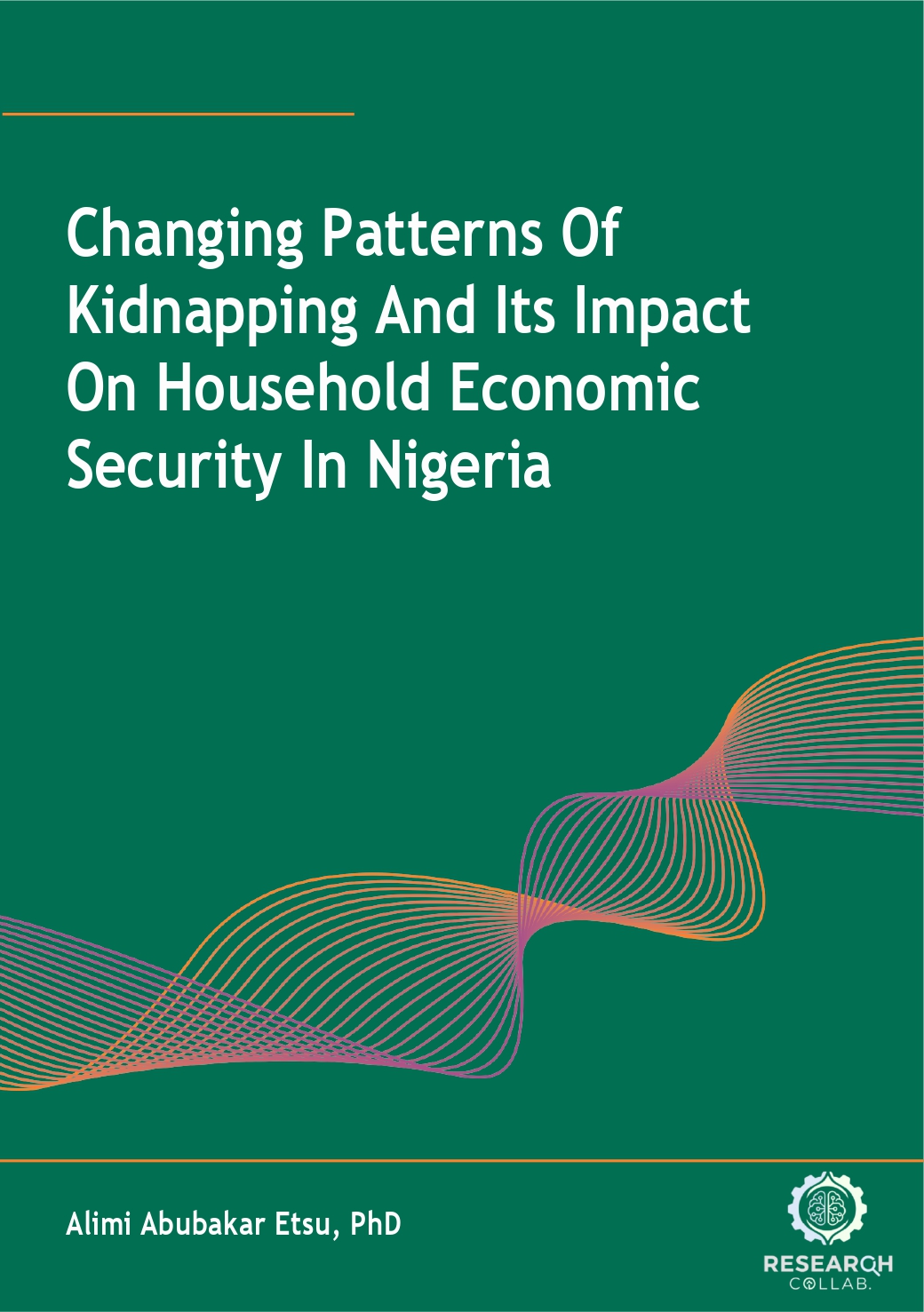
Changing Patterns Of Kidnapping And Its Impact On Household Economic Security In Nigeria
##plugins.pubIds.doi.readerDisplayName##
https://doi.org/10.5281/zenodo.21489499
Keywords:
Kidnapping, Household economic security, Changing patterns, UnemploymentSynopsis
Kidnapping over time has changed in form, context and pattern into a sophisticated organized crime, taking on more sinister motivations, political and economic underpinnings with dire consequences on the sustainability of the economy of affected households. The study examined the changing patterns of kidnapping and its impact on household economic security in Nigeria.The study adopted a survey research design, and using a multistage sampling procedure, the survey covered a total of 400 households, across 4 selected states of Borno, Kaduna, Rivers and Lagos States. Both the descriptive and inferential statistics were employed to analyze the data collected. The null hypotheses formulated for the study were tested usinga one-way sample test to compare the mean of more than two, while Multiple linear regression analysis was used to test of significant of the effect of kidnapping on household economic security in Nigeria and the findings reveal that the trending pattern of kidnapping in Nigeria are victim profiling and random kidnapping while socio-economic factors, particularly unemployment, poverty and poor parental upbringing would significantly predict individual's participation in kidnapping; and insecurity and flamboyant lifestyle will likely expose an individual to the risk of being kidnapped.The study concluded from the findings that kidnapping negatively impact household economic security, particularly as it leads to financial and revenue loss, forceful closure of business and forced relocation, out of school children and abandonment of developmental projects amongst other household security indicators. It was thus recommended amongst others that government improve the capacity of security agencies to rescue kidnap victims without the payment of ransom with the view to reducing the effect of kidnapping on household economic security in Nigeria while also engaging all relevant stakeholders towards identifying region specific trend of kidnapping with the view to nipping it in the bud.
References
Adebayo, A. A. (2013). Youth unemployment and crime in Nigeria: A nexus. International Journal of Sociology and Anthropology, 5(8), 350–357.
Alemika, E. E. O., & Chukwuma, I. C. (2004). Criminal Victimization and Fear of Crime in Lagos Metropolis, Nigeria. CLEEN Foundation.
Collier, P. (2007). The Bottom Billion: Why the Poorest Countries Are Failing and What Can Be Done About It. Oxford University Press.
Federal Republic of Nigeria. (2014). Terrorism (Prevention) (Amendment) Act, 2013. Federal Government Printer, Abuja.
Global Initiative Against Transnational Organized Crime. (2021). Kidnapping for Ransom in Africa: Trends and Policy Responses. https://globalinitiative.net/
National Bureau of Statistics. (2022). Nigeria Crime Experience and Security Perception Survey 2022. Abuja, Nigeria. https://www.nigerianstat.gov.ng/
Nwagboso, C. I. (2012). Security challenges and economy of the Nigerian state (2007–2011). American International Journal of Contemporary Research, 2(6), 244–258.
Okoli, A. C., & Agada, A. T. (2014). Kidnapping and national security in Nigeria. Research on Humanities and Social Sciences, 4(6), 137–146.
Onuoha, F. C. (2010). The Islamist challenge: Nigeria's Boko Haram crisis explained. African Security Review, 19(2), 54–67.
United Nations Office on Drugs and Crime. (2019). Global Study on Homicide 2019. United Nations. https://www.unodc.org/
United Nations Office on Drugs and Crime. (2023). Global Study on Homicide 2023. United Nations. https://www.unodc.org/
World Bank. (2020). Nigeria Development Update: Rising to the Challenge. World Bank. https://www.worldbank.org/en/country/nigeria
World Bank. (2022). Nigeria Development Update: The Continuing Urgency of Business Unusual. World Bank. https://www.worldbank.org/en/country/nigeria
World Economic Forum. (2023). The Global Risks Report 2023. https://www.weforum.org/reports/global-risks-report-2023/
Zenn, J. (2020). Unmasking Boko Haram: Exploring Global Jihad in Nigeria. Lynne Rienner Publishers.
Published
21 July 2026
Copyright (c) Nong Bang Nguyen
Details about the available publication format: E-Book
E-Book
ISBN-13 (15)
978-81-687019-7-7
Details about the available publication format: Book (Paperback)
Book (Paperback)
ISBN-13 (15)
978-81-687019-6-0
How to Cite
Download Citation







 WhatsApp +91 6002313260