
Living with cultural heritage: Building the Brocade Weaving Club of the Jrai Woven in the Context of the Cultural Space of the Gongs in Pleiku City, Gia Lai Province, Central Highlands, Vietnam
##plugins.pubIds.doi.readerDisplayName##
https://doi.org/10.5281/zenodo.21348668
Keywords:
Brocade weaving , Central Highlands, Cultural Space of the Gongs,Cultural Heritage,Gia Lai; Jrai, Urban, Vietnam, WomenSynopsis
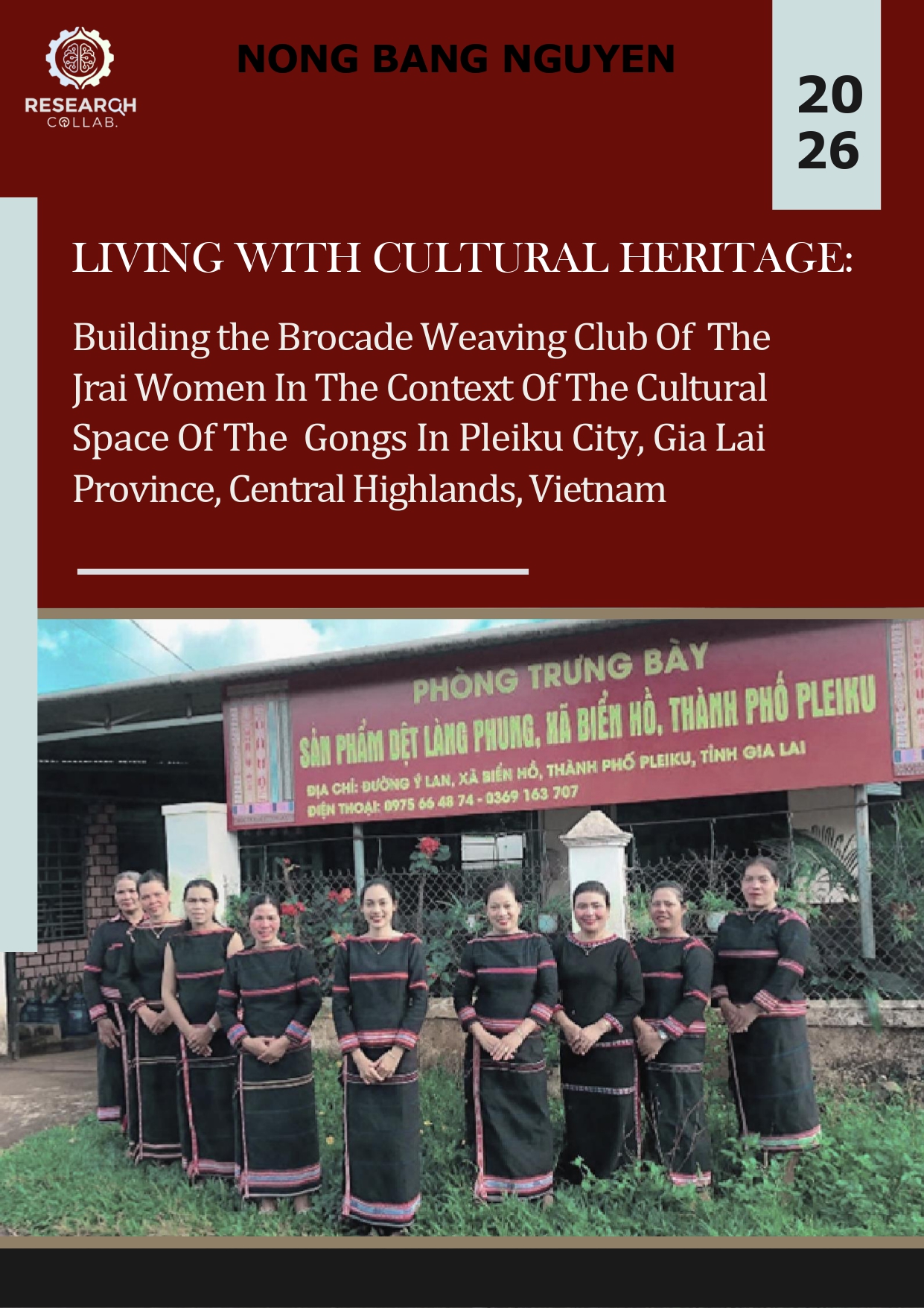
The book explores the preservation and promotion of traditional handicrafts among ethnic minorities, focusing specifically on the brocade weaving of Jrai women in the context of the Cultural Space of the Gongs in Pleiku City, Gia Lai Province, Central Highlands, Vietnam. Amidst rapid urbanization and socioeconomic shifts, the unique cultural heritage of the Jrai people is facing significant erosion, with younger generations showing decreased interest in ancestral trades. To counter this decline, the research proposes a traditional handicraft club model that safeguards cultural heritage while simultaneously fostering sustainable livelihoods and reducing poverty. The study assesses the current state of Jrai brocade weaving, a craft deeply embedded in the community's identity and traditionally passed down through generations of women. Today, however, the practice is threatened by several compounding factors:
•Ecological changes and shifting agricultural priorities have severely reduced local cotton cultivation, diminishing the traditional supply of raw materials. :
•Modern lifestyles and industrialization have fostered a consumer preference for cheaper, ready-made, mass-produced clothing over time-consuming hand-woven garments. :
•The growing influence of imported religions has altered traditional belief systems, reducing the frequency of indigenous festivals where traditional attire is prominently worn. :
•Younger generations increasingly view the craft as economically unviable compared to faster-paying labor opportunities, leading to a critical shortage of successors. :
To address these economic and cultural challenges, the researchers spearheaded the formation of a Jrai brocade weaving club in Phung Village, Bien Ho Commune. The club operates on a cooperative model aimed at pooling resources, standardizing product quality, and preserving core aesthetic values-such as traditional geometric patterns (e.g., communal houses, natural motifs) and the signature five-color palette (black, red, white, yellow, and blue).
Crucially, the club serves as an economic vehicle. By establishing a dedicated display space near popular tourist sites such as Bien Ho Lake, the club connects artisans directly with consumers. This ensures members have a stable income, transforming cultural preservation into a tangible economic asset rather than a purely ideological goal. The study concludes that sustainable preservation requires robust, systemic support. The authors recommend that local authorities deeply integrate traditional crafts into broader tourism development strategies. Furthermore, the research stresses the importance of providing state funding, officially recognizing skilled practitioners as "Folk Artisans" to encourage mentorship, and integrating craft education into local ethnic boarding schools. Ultimately, the research argues that establishing structured artisan clubs, supported by government policy and commercial tourism, is a vital mechanism for maintaining the Jrai people's cultural continuity and economic resilience in a modernizing world. :
References
Adamson, G. (2019). Thinking through Craft. Bloomsbury Publishing.
Amin, I. M. (2006). Manufacturing and marketing of traditional crafts: Malaysian perspective. APEC/SME Seminar on Support for Local and Cottage Industries (pp. 1–19).
Association of Southeast Asian Nations. (2014). ASEAN Ministerial Meeting on Women. ASEAN Socio-Cultural Community.
Babbie, E. (2004). The Practice of Social Research. Wadsworth Publishing.
Ban Dan toc tinh Gia Lai. (2021). Bao cao viec thuc hien De an "Day manh cong tac pho bien, giao duc phap luat va tuyen truyen, van dong dong bao dan toc thieu so va mien nui giai doan 2017–2021" tren dia ban tinh. Gia Lai.
Bao Khanh. (2022). Du lich Gia Lai: Bien tiem nang thanh nguon luc thuc te. Bao Ha Noi Moi Online. https://hanoimoi.com.vn/tin-tuc/Du-lich/1049137/du-lich-gia-lai-bien-tiem-nang-thanh-nguon-luc-thuc-te
Berma, M. (2001). Constraints to rural community involvement and success in non-agricultural activities: Some evidence from Sarawak, Malaysia. Humanomics, 17(1), 99–115.
Bernard, R. H. (2000). Social Research Methods: Qualitative and Quantitative Approaches. SAGE Publications, Inc.
Birchall, J. (2004). Cooperatives and the Millennium Development Goals. International Labour Office, Geneva. http://www.community-wealth.org/_pdfs/articles-publications/outside-us/book-birchall.pdf
Birchall, J. (2003). Rediscovering the Cooperative Advantage. International Labour Organization, Geneva. http://www.acdivoca.org/acdivoca/CoopLib.nsf/d40b394e0533f5b285256d96004f1ad4/e23f0c803fc6060485256ef400575ed8/$FILE/Rediscovering%20the%20Cooperative%20Advantage.pdf
Published
10 July 2026
Copyright (c) Nong Bang Nguyen
Details about the available publication format: E-Book
E-Book
ISBN-13 (15)
978-81-687019-5-3
Details about the available publication format: Book (Paperback)
Book (Paperback)
ISBN-13 (15)
978-81-687019-4-6
How to Cite
Download Citation





 WhatsApp +91 6002313260