
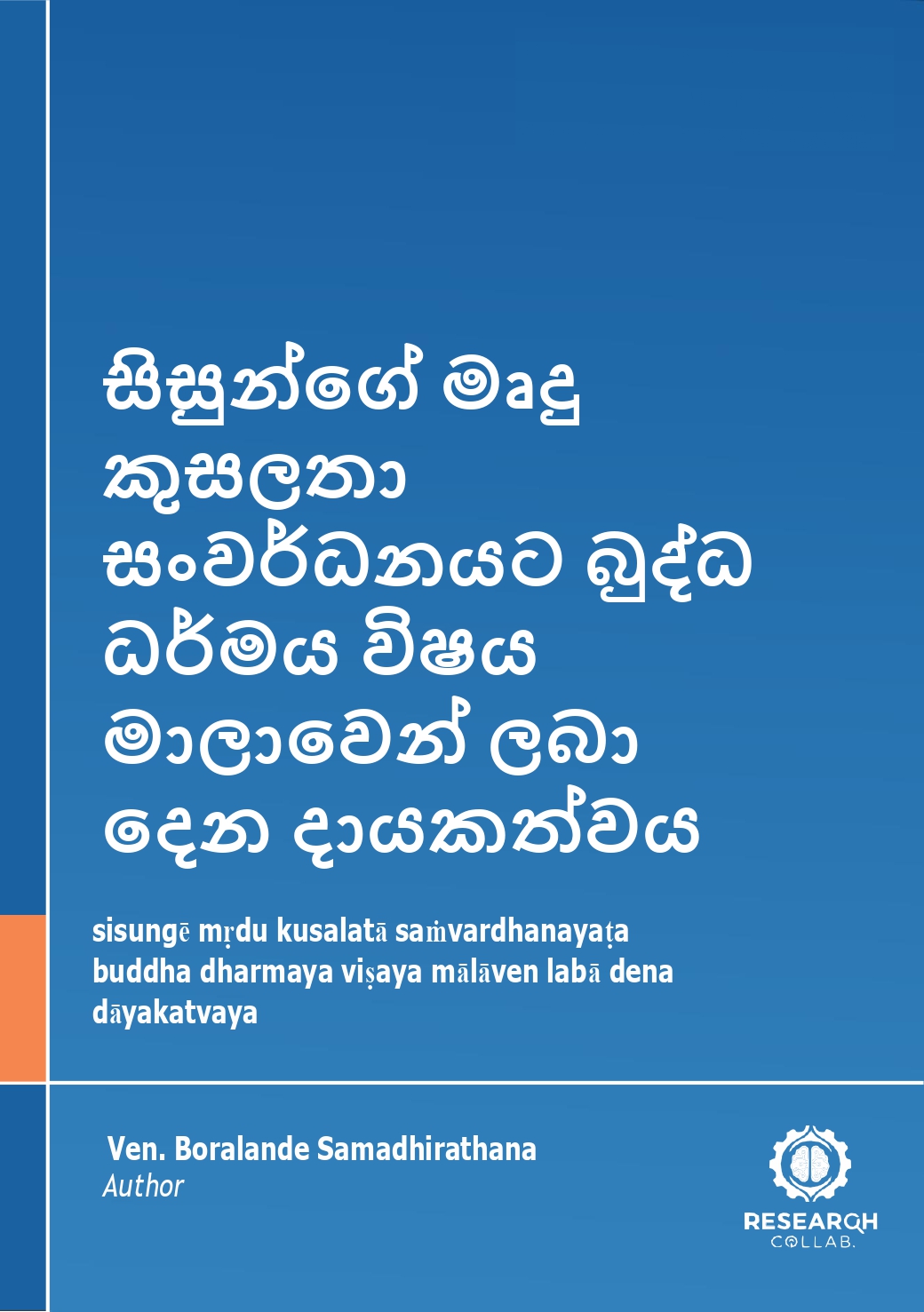
sisungē mṛdu kusalatā saṁvardhanayaṭa buddha dharmaya viṣaya mālāven labā dena dāyakatvaya
##plugins.pubIds.doi.readerDisplayName##
https://doi.org/10.5281/zenodo.21064132
Keywords:
Grade 10 Buddhism curriculum, Soft skills, Cognitive-Behavioral Gap, Sri Lanka, Secondary education, Emotional Intelligence, Activity-based learningSynopsis
This study explores how the Grade 10 Buddhism curriculum contributes, to the growth of soft skills , mainly communication, leadership and problem-solving among secondary learners in the Gampaha Educational Zone Sri Lanka. In a modern schooling system that leans toward whole-person development, this research tackles the key “Cognitive-Behavioral Gap” , where students’ strong conceptual understanding of Buddhist ethics does not really become practical behavioral competencies. Using a mixed-method approach, the research followed a descriptive survey design. It involved a stratified random sample of 322 Grade 10 students, plus 30 teachers and 7 principals. Data were then cross-checked through student and teacher questionnaires, semi structured interviews and classroom observations, then handled with both statistical tools (SPSS) and qualitative content analysis. The results show that the Buddhism curriculum has a deep theoretical structure that matches contemporary soft skill perspectives, like Servant Leadership and Emotional Intelligence. Still, the quantitative results point to a noticeable mismatch between passive abilities, for instance listening and patience (Mean = 3.82) , and active abilities such as public speaking and leadership initiative (Mean = 3.22). The study also highlights structural obstacles including an exam centric teaching style and a sort of “Leadership Monopoly” within classrooms. Because of this, learners get fewer chances to participate practically, and they cannot easily apply what they learned, like the “Ten Royal Virtues” or “Right Speech” in everyday situations. So, the research finally argues that although the curriculum is logically solid, the way it is delivered falls short for developing active soft skill. To close this gap, the thesis recommends.
References
Bandura, A., & Cervone, D. (1986). Differential engagement of self-reactive influences in cognitive motivation. Organizational Behavior and Human Decision Processes, 38(1), 92–113. https://doi.org/10.1016/0749-5978(86)90028-2
Barbuto, J. E., Jr., & Wheeler, D. W. (2006). Scale development and construct clarification of servant leadership. Group & Organization Management, 31(3), 300–326. https://doi.org/10.1177/1059601106287091
George, J. M. (2000). Emotions and leadership: The role of emotional intelligence. Human Relations, 53(8), 1027–1055. https://doi.org/10.1177/0018726700538001
Greenleaf, R. K. (1977). Servant Leadership: A Journey into the Nature of Legitimate Power and Greatness. Paulist Press.
Kolb, D. A. (2015). Experiential Learning: Experience as the Source of Learning and Development (2nd ed.). Pearson Education.
Miao, C., Humphrey, R. H., & Qian, S. (2021). Emotional intelligence and servant leadership: A meta‐analytic review. Business Ethics, the Environment & Responsibility, 30(2), 231–243. https://doi.org/10.1111/beer.12332
Ministry of Education, Sri Lanka. (2020). Teacher's Guide: Grade 10 Buddhism. Ministry of Education.
National Institute of Education. (2020). Grade 10 Buddhism Syllabus. National Institute of Education, Maharagama, Sri Lanka.
UNESCO. (2021). Reimagining Our Futures Together: A New Social Contract for Education. UNESCO Publishing. https://unesdoc.unesco.org/ark:/48223/pf0000379707
World Economic Forum. (2025). The Future of Jobs Report 2025. https://www.weforum.org/reports/the-future-of-jobs-report-2025/
Published
6 July 2026
Copyright (c) Ven.Boralande Samadhirathana
Details about the available publication format: E-Book
E-Book
ISBN-13 (15)
978-81-687019-1-5
Details about the available publication format: Book (Paperback)
Book (Paperback)
ISBN-13 (15)
978-81-687019-0-8
How to Cite
Download Citation




 WhatsApp +91 6002313260